


Game 35: Hades II

The developer Supergaint Games has made five games, and four of them - Bastion, Transistor, Hades, and now Hades II - are isometric combat action games. It's clear that Supergiant loves making this type of game, and they've had a lot of experience doing so.
The original Hades distinguished itself to become one of my favorite roguelites of all time, in part because it cleverly incorporated all of the mechanics of a roguelite - explicitly including your inevitable death and rebirth - into a plausible narrative. Your various power-ups on a run are boons granted to you by the Gods of Olympus, and as Zagreus your initial goal was to break out of the Underworld (nobody escapes!) - with the ultimate opposition being your own father Hades, who would have conversations with you after your failures and served as the game's final boss.
Only he wasn't all that final - because after 'winning' the first time, you meet your mother Persephone, and after just a few moments find out that Zagreus cannot sustain himself outside the Underworld. To truly see the full story play out requires beating it multiple times, increasing the difficulty against yourself further and further.
The story is excellent, there are a ton of wonderful characters to meet, and there is a staggering amount of dialogue - as in, I googled 'How much dialogue is there in Hades' because there seemed to be no end to it, which is astonishing for the roguelite genre - these games often don't get much further than 'Retrieve the Amulet of Yendor' and call it a day.
All of which is to say that I have high hopes for this game, and while I try to avoid reviews and spoilers for games I haven't played yet I've heard great things - the original Hades has a well deserved reputation and I'm far from the only person to eagerly await its sequel.

Run 1:
In an action roguelite, you make repeated attempts (runs) to finish the game but generally begin so weak that only near-perfect play will actually let you succeed. After you fail, you've generally acquired some form of either currency or bonus that carries over into future runs and makes you stronger - as long as you're obtaining these, you're making progress through the game, and eventually a combination of your own improving skills and the permanent bonuses to your character accumulate to the point where you can beat the game.
This differs from full roguelike in which you don't acquire these permanent bonuses, and every new run begins with your character in the same state as it was before, and beating the game is entirely reliant on your own skills.
Instead of Zagreus, we're playing as Melinoë, who I don't recognize from the first game. I note that she has different colored eyes, which Zagreus also had.

The gameplay is instantly familiar to me - they haven't changed much from how Hades feels combat-wise which to my mind is a good thing, as it's got one of the most fun combat systems around.
I've been thrown directly into Erebus and we're battling lost souls. In this game Erebus is the first area, long in shadow and decay - I think in myth Erebus is a God unto itself but Hades doesn't pretend to be an exact retelling of Greek mythology, they put their own interpretation on things.
Melinoë appears hell-bent (sorry) on killing the Titan Chronos.

What mainly distinguishes runs from each other in Hades I and II is that you get different boons from the Olympian Gods - each one offers a selection of powers that can alter and enhance one of your attack types, your dodge, or a number of passive or triggered effects.

The abilities are themed to the God - Poseidon, for instance, has a lot of water-based attacks that tend to shove enemies around.

Combat takes place within a single room, and for the majority of them the objective is simple - kill everything that isn't you. In addition to your own variety of attacks, you can use the room's terrain and traps to harm foes, which makes for a fun and vibrant battles.
After clearing a room, you get whatever the reward for that is, and then you get to pick the next room's rewards.

The initial enemies in Erebus aren't all that challenging, in part because this game is so mechanically similar to its predecessor that it already feels familiar to me. In no time I've reached the first area's boss.
That would be Hecate, who is apparently my tutor and headmistress.

Between my pitiful starting health pool and being wholly unfamiliar with her attacks, I die. Not a bad first attempt at all - I think it took me a couple runs in Hades before I reached the first boss.

Wherever this between-runs area is, it's where we'll get to meet some other characters, enhance our abilities, and learn more about what's going on.

All right, so there's Hades acting as a moody background, with his wife Persephone on the right and their son / Hades I hero Zagreus on the left, and little baby Melinoë being enjoyed by everyone (except Hades, he's just that kind of Dad). There's another departure from the traditional myth - Zagreus and Melinoë are children of Hades here rather than of Zeus.
I don't have the full story of what happened yet but as near as I can surmise, the Titan Chronos has kidnapped everyone in the family except me. No idea why, but this is enough for everyone around me to be down with killing the guy - so Death to Chronos!
Hecate is here, offering encouragement - she didn't expect me to succeed on the first attempt. Nor did anyone else.

I find an altar where I can use my accumulated ashes (The gray symbol from earlier) to unlock Arcana cards, which are permanent upgrades - though it looks like there are only nine of them, which seems low.

Just before setting out on another attempt, there's a training room complete with one of my favorite characters from Hades - Schelemeus. He's a living skeleton who serves as a training dummy that you can practice your attacks on - it's fine, he'll come right back if you kill him.

And with that, it's time to try again.
Run 2:
The Gods you run into and the abilities they offer can greatly affect your build and ensuing playstyle for a run. Sometimes you end up with an interesting mix of abilities, and sometimes you can enhance one particular type of attack to such a degree that it becomes your weapon of choice.

In this case, Demeter's enhancement to my special attack lets me freeze enemies a good distance away, holding them in place and letting me pick them off safely. I've taken hardly any damage by the time I clear Erebus and reach Hecate again, and this time I've picked up some additional health along the way so I can afford to make some mistakes in this battle.

I hope Hecate teaches me the sheep transmogrification thing, that would come in handy!
This time I defeat Hecate and she allows me to continue to the next area. In the original Hades you were always trying to proceed upward to escape - this time I'm trying to head deep into the bowels of the Underworld to where Chronos resides. Right at the start I meet Eris, who I think is on my side, but she leaves me with a "blessing" that makes me more vulnerable to damage.

Ahead looms the second area, Oceanus, an aquatic-themed mess of pipes and waterfalls.

The fish-themed enemies here are notably tougher and faster, and I'm feeling underpowered. Despite that, I make good progress and don't take too much damage - at first.

Sometimes in the room selection you'll see a skull appear above a door. This indicates that a particularly difficult room lies beyond, but if you can do them then you're in for a better reward than you ordinarily get. If you want to have a particularly powerful build, it's a good idea to complete these rooms - assuming they don't kill or cripple you, you'll be better off in the long run. So I tried the first skull room that I saw.

I won, but just barely - I was down to 10 life. Thanks to my upgrades I currently heal 3 health per room, but that's not sufficient to fix the situation - low health means no room for mistakes, and healing items are few and far between in Hades II.

All of the Witch Staff's attacks have an alternate 'Omega' version that happens by holding down the attack button, it both uses up your magic and does a lot more damage.
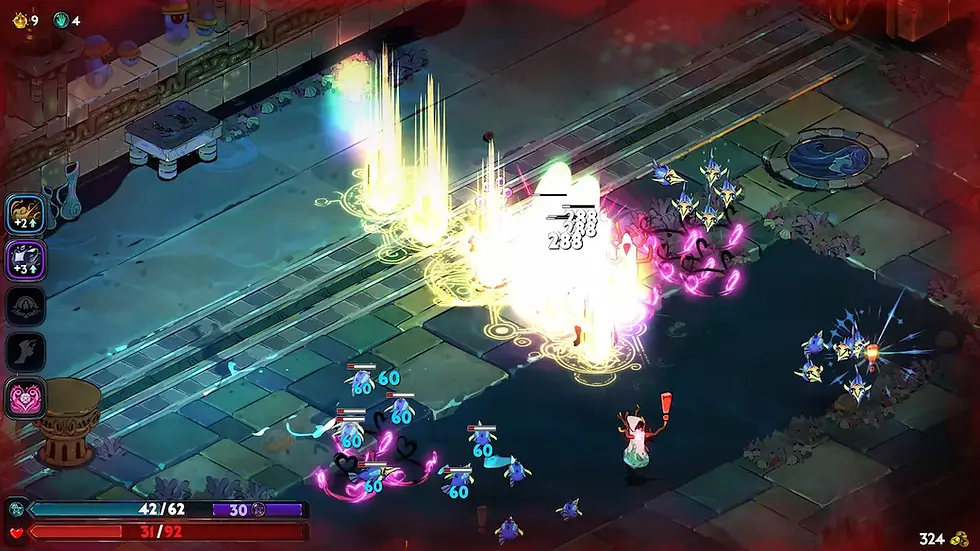
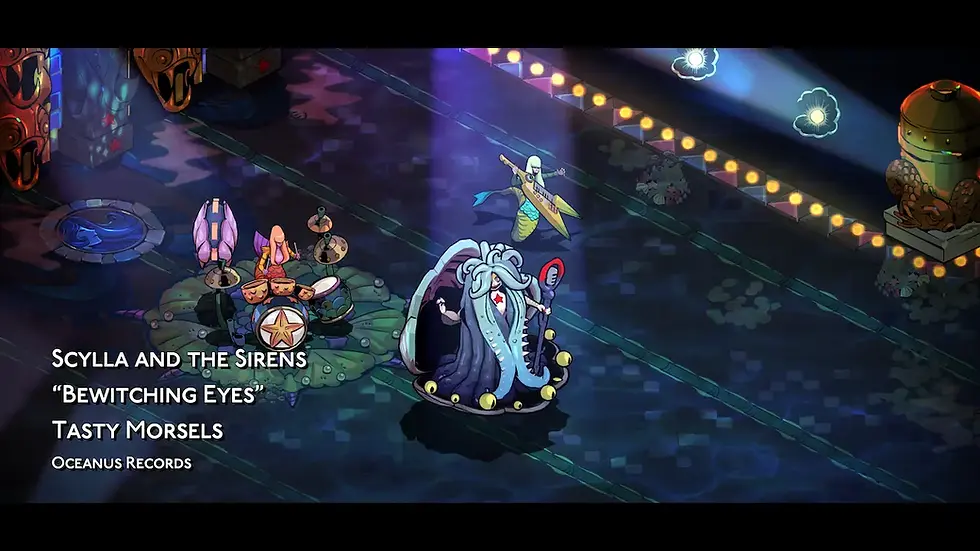
I recovered some health from a shop but I still wasn't back to full strength by the time I encountered the second boss - the Sirens.

This is amazing, Scylla and the Sirens are a full-on band and they're playing the boss music themselves for this fight! I am beside myself on this one, the song is just great.

After resurrection, you can confide in a large frog nearby and share your woes. You can also kiss the frog, but doing so merely turns it into a kissed frog.
There are already some significant upgrades here at camp - first and foremost Hecate has finished purifying the Cauldron, which can be used to unlock further camp upgrades.

The Arcana cards expand much more than the initial nine I was presented with, there are a lot more than nine and I don't know how many there are at this point.
I also have my first trinket - I can take one of these per run, which will provide some form of bonus. You level up the trinkets by using them.

Nemesis in camp is not at all impressed with me.

Run 3:
Thanks to mining tools, I can now harvest silver from resource nodes.

My third attempt begins with encountering a new Goddess:
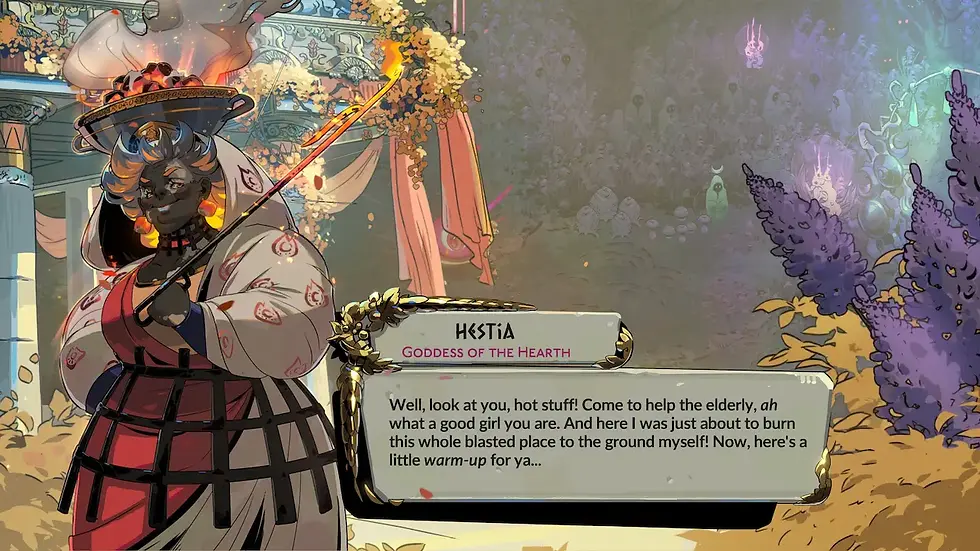
I particularly like the way the UI for these flames works - the enemy's health bar gets an orange chunk inside it, which helpfully indicates whether the fire is going to finish them off or not if the entire health bar is orange.
A couple rooms in, I see an upgrade that I always sought in Hades - a Daedalus hammer, which grants you powers based on the weapon you have equipped. Many of these upgrades are significant and can help immensely.

At this point in the game my ability to recover hit points is pretty limited, so being able to restore 5 HP by killing an enemy in the correct way is huge - it's not uncommon to be able to kill multiple enemies in a room this way and recover a whole lot if I need to.
We're still on our 'meet the cast' tour of the many characters we'll encounter - Artemis pops into an encounter to help me kill everything and then chat afterwards.

The burning plus life recovery is proving to be a very effective combination, and even Hecate spawns in monsters a couple times that just serve to let me recover hits. Despite being turned into a sheep again (I have to learn to avoid that!) I defeat Hecate and move on.
Entering Oceanus, a mysterious figure is waiting for me.

He slinks off after Melinoë rebukes him, guess I'll find out later.
Oceanus features those large schools of fish, which have now become a huge pile of HP recovery with Vampiric Cataclysm - even when I take hits I'm back to full by the time the room is over.
I also ran into a self-absorbed guy.

If this plays out like Hades I then I assume Narcissus lives here in Oceanus, and I'll find him regularly here to both play out his story and get help from him.
Initially the limiting factor for recovering life is that the attack I need to use costs magic, so I can only do it so many times - but there are abilities that let you recover your magic, and I pull a great one.

I ran into a different mid-boss, this angry seahorse. He might have been having an off day.

So I'm still at full life when I reach Scylla, and not only that - I've improved my base hit points a lot by picking up life increase hearts frequently. The more HP I have, the more mistakes I can afford to make.
I still don't know the fight that well and Melinoë and the Sirens trade hits over and over until both sides are on the ragged edge of death.
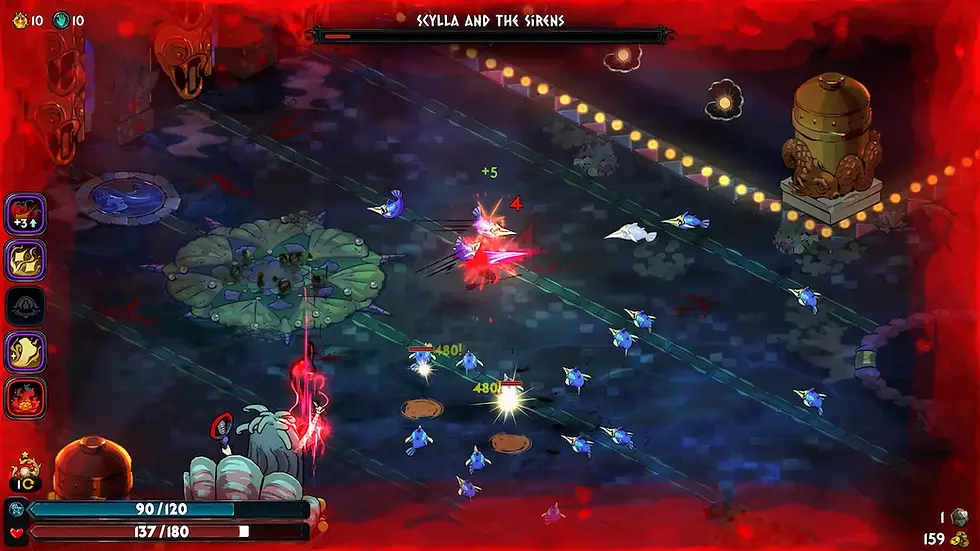
Once the fish minions appear, it's a smorgasbord - I recover all my health and finish her off for my first victory over the Sirens. As a nice touch, the area just past the stage is the Siren's dressing room.
Beyond Oceanus, the bleak and wide fields of Mourning.

Eris is waiting for me here, and gives me another 'Blessing' - I wonder if she's here intentionally to prevent me from beating the game too quickly, as this build is proving extremely robust and I'm wondering if it could go all the way. Eris' curse will help ensure that doesn't happen as enemy damage ramps up against me for every encounter going forward.
The Fields of Mourning have a different structure than the prior areas - instead of discrete rooms we have much larger open areas with multiple rewards scattered around, and taking the main ones prompts enemies to appear and attack you. I could see this being a place that will attrit me most times, but the Vampire can take it all and keep going strong. I'm still at full health when I get to the end.
The boss here is an old friend, and it pains me to see him like this.

Hades I Cerberus casually lounges around the throne room and you can pet him because he's a good boy. He's supposed to help flight Zagreus and prevent his escape from the Underworld but instead he just lets Zagreus walk by him in exchange for a doggie treat.
Melinoë is going to have a much harder time with the three-headed guardian. I've got a lot of health but... I mean, look at this.

It's too much, and Eris' curse doesn't help. Run 3 ends in the jaws of Cerberus.
I don't resurrect right away. Instead we get a picture of young Melinoë growing up, playing hide and seek with Hecate.

There's more things to unlock back at camp, including a farm plot where I plant some poisonous berries. Since she was raised by a witch it seems Melinoë follows after her foster mother's example.

Run 4:
Did I mention there are a lot of characters to meet? Selene shows up with various Hexes, which I can use in a room after I burn through an amount of mana.

Also, I ran into someone who lives in Erebus. Normally spiders are scary but you're about to see a counterexample.

Arachne's benefits are neat, you can pick an item of clothing that grants you temporary armor, and so long as that armor lasts you also get a unique ability, such as regenerating magic.
Oh, and I got my wish - the hex I took from Selene lets you turn enemies into sheep!

I'm not immediately enamored with these Sister Blades, but I expect the weapons in Hades II will eventually become quite a bit more powerful and distinct than their original forms, plus I'm still getting used to them. I enjoy shorter ranged weapons because fighting toe to toe is a blast, but it does tend to hurt.
As an example of the detailed dialogue that's gone into this game, Hecate has her own line - multiple lines, in fact - for when she gets hit with the hex that turns her into a sheep.

As a reward for beating her, Hecate hands me the Book of Shadows. It's the game's codex, with entries about all the characters, enemies, areas and so forth and each page will reveal more information in time.
Early in Oceanus, that creepy guy from before shoes up - it was indeed Chronos, and he decides to interfere directly in my efforts by sending me to Asphodel.

Asphodel is a fiery place that I fought through many times as Zagreus from the first game - this time you only have to beat one hard room in it to escape, but I'm pretty hurt afterward.

I'm not in great shape by the time I reach the Sirens, but to my surprise after having been beaten once, they've got a whole new song to play! In fact, Oceanus itself has been playing a different soundtrack since I got here. How much music did they write for this band?

Asphodel left me weak, and I couldn't beat the band this time.
After I die, but before I resurrect, a servant of the three Fates contacts me.

Moros brings me the Fated List of Minor Prophecies, which is a fancy way of saying 'Here's a list of quests we'll reward you for'.

Run 5:
This time the first god I run into is Zeus, the big man himself.

Now I've got an ability that makes a thunder cloud appear over foes, and then when I deal enough damage to them it hits them with a lightning bolt, thus piling on the damage to a single target.
Aside from being turned into a sheep yet again, I'm getting much better at the Hecate fight and get past it while only suffering a single hit.
Chronos is waiting between the worlds again to taunt me. I take a swipe at him but he just laughs and departs.
All of the voice acting in the game is great, but I want to give special recognition to the guy playing Narcissus, he really manages to hit a perfect note here.

I'm not great at the Siren battle yet but I've gotten good enough to pull through it again this time and reach the Fields of Mourning.
Eris is here again to hurt my chances of making it through this place. I'm very curious as to what causes her to appear - and it's not all bad, in addition to her 'blessing' she also leaves behind a significant amount of between-run upgrade materials.
I've gotten an armor-destroying ability so now's as good a time as any to discuss one of Hades' combat mechanics. Normal run-of-the mill enemies and even mid-bosses will get briefly stunned when you damage them, so with most weapons you can be aggressive and throw yourself into attacking your foes and stun lock them until they're dead - the main threat then comes from other enemies and traps that can hit you while you're beating the crap out of your target, so you need to balance your crap-beating with frequent dodging and running around. 'Elite' enemies spawn with a yellow armor bar, but besides simply having more health the real problem is that you don't stun armored enemies when you hit them and interrupt their attacks, so they'll hit you right back if you try it - you need to be much more careful engaging such foes as your target remains a serious threat until that armor breaks, which is all the more problematic when your weapon is a short ranged as these blades are.
I picked up a 'Duo' ability - these can appear when you have powers from two particular gods, and in this case Zeus and Poseidon team up to give me a 'splash ball' which forms when I run around for a bit to charge it up and then unleash into a large, damaging splash attack.

I also meet the NPC of the Fields, and this is a strange one.

Despite not being a great conversationalist she gives me a dodge ability that saves me several times and almost gets me through the battle against Cerberus.
Almost.
Back at camp, I get a couple major upgrades from the Cauldron - a specific weapon each night will have a 'grave thirst' which means it generates bones for that run - bones can be traded at a local shop for other mid-run currencies. I also obtain a lifespring in Erebus which will give me some mid-area healing. I don't need a lifespring for Erebus but eventually I should be able to get them for Oceanus and the Fields and I'll be damn glad to have them.
I don't think I've mentioned a couple characters in camp - there's Dora the schizophrenic ghost who offers encouragement or attempts to frighten me, and there's also the ancient hero of old, Odysseus. Here he reminisces about his own encounters with the siren.

In Hades I, Hypnos, the god of sleep would usually greet Zagreus after his many deaths. Ever since Melinoë was a child Hypnos has been locked in a deep sleep, but on a whim I try giving him a gift of Nectar and he actually responds by mumbling something.

Before setting out I unlock the Umbral Flames. They're a bit strange to wield - you can move (slowly) while firing slow projectiles. These will take some getting used to.

Lastly, there's a stop in camp where you can look up and see the moon. I initially assumed it was a static picture but it just struck me that the moon phases are probably important - Hecate even mentioned that she didn't expect me to succeed on a New Moon on my first run.

Run 6:
Hermes shows up to greet me right away.

This conversation feels pretty important, and it's followed up with Hecate telling me to stay on the task I've been assigned - I'm curious how and when I might try to get to Olympus, that would be a pretty cool addition to the game.
Hephaestus also appears for the first time and grants me a pretty great alpha-strike ability.

Did I mention I didn't need a lifespring for Erebus? Karma heard me - this time I take a lot of damage trying to get used to wielding the Flames - it's actually my worst run so far through the area.
Between Hephaestus and Selene I get a big whomping attack and a death-star laser beam, tempered by the fact that I move like a snail during the former and not at all during the latter. I have great damage and terrible survivability. The battle against the Sirens couldn't be closer as I get down to 5 health.
At least Eris isn't waiting for me in the Fields this time.

I honestly didn't expect to reach Cerberus this run but the fields goes exceptionally well as I gain a better handle on this weapon and my capabilities - I get a big life increase and also pick up the dodge ability again from Echo.
This run has come a long way from almost dying in Erebus.


A cured Cerberus happily bounds away into the Fields, likely to be re-evilified by the time I return here. I enjoy the moment of triumph - Chronos had better watch out because I'm making great progress.

Tartarus was the first area in Hades so of course it's been made much more difficult. You can choose either a direct route to Chronos or you can take detours, fighting through additional rooms for significant upgrades.
I am seldom inclined to pass on the acquisition of power.
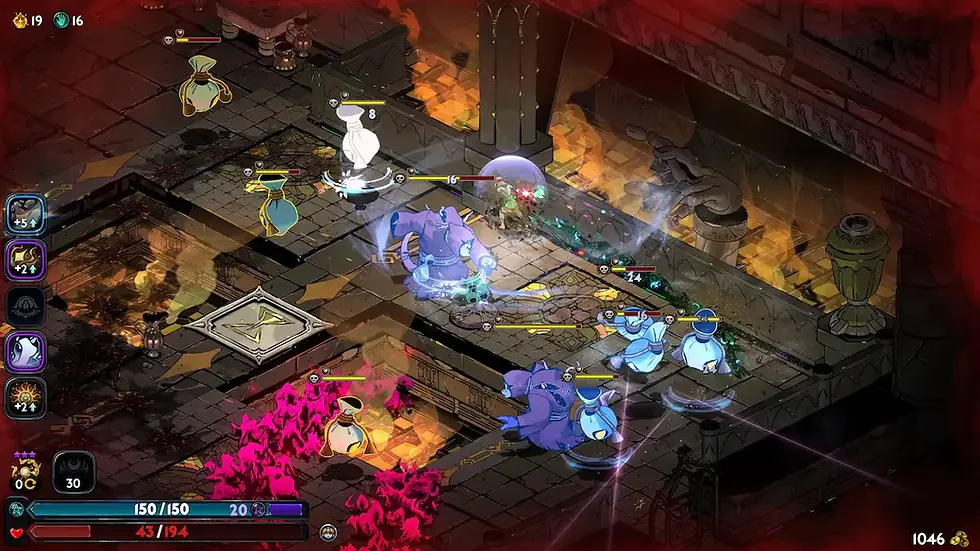
The enemies here are a mix of enhanced foes from the original plus some time-themed foes, and... uh... angry bags.

Run 7:
I had a plan where I'd try a cast-based build this time and leave giant flaming circles in my wake, and I died at Hecate.
I did meet Chaos though, a familiar risk / reward option from the previous game. Chaos first curses you, but if you survive the experience the curse changes to a nice benefit.

Thanks to a semi-combative discussion about the matter with Hecate, I now have a recipe (but not the ingredients) for something that will break the ward that leads upward towards Olympus. Other characters are starting to weigh in on the matter.

Selene on the other hand sees it as a distraction from my main task.

Run 8:
I really did like the idea of having a large fiery casting circle so I grab Hestia's trinket to help encounter her early and try it again. You never have full control over your build in Hades but if you want a particular ability that's often in the cards, especially if you stack the deck a bit.

This time I pick up some synergies for it - by the time I beat Hecate my attack and special are still basic attacks, but my casting circle now burns enemies inside it, slowly expands and gets larger while it exists, and if I use the Omega version it finishes off with a burst of extra damage a couple seconds after it collapses.
This build may be a one-trick pony, but that's perfectly fine when it's a good trick.

It works particularly well against the Sirens - since there's three of them I can simultaneously damage two or even all three while focusing my energy on dodging. It's even good enough to get through the Fields and take down Cerberus.
Unfortunately Eris is waiting at the entrance to Tartarus to put the kibosh on a highly successful run. What's her deal anyway?
I'm noticing more of Chronos' changes to Tartarus, he's build large clock-like mechanisms around the place, and notably the blood of the river Styx has been replaced by the Sands of Time.


This time I'm lucky enough to stumble across a prisoner... the big man himself! He's alive!

Hades sends me on my way with some life restoration, and being a little more judicious about which upgrades to pursue leaves me in good shape when I reach the House of Hades - currently occupied by our villain.

The battle actually doesn't strike me as being quite as nasty as Hades was to fight in the original, at least initially. That said I haven't done it before, and thanks to Eris, Chronos hits like a truck.

Despite my defeat I'm pretty happy to have gotten this far so quickly. Difficulty-wise this feels close to where Hades I is.

I start brewing a shadow potion that should be the last ingredient I need to break the ward heading for Olympus, but it needs time (in the form of fighting encounters on runs) to finish, so it's back to the depths for now. I'm very excited to try heading upward and see what's going on with this alternate path.
Run 9: I've unlocked the Axe but have yet to use it - since the weapons have Grave Thirst I'm using whichever weapon has it in order to get extra bones, and tonight it's back to the Witch Staff.
I've still got Hestia's trinket and I get a really neat ability from her this time - another Cast modification, but this time it's a full-on fireball spell!
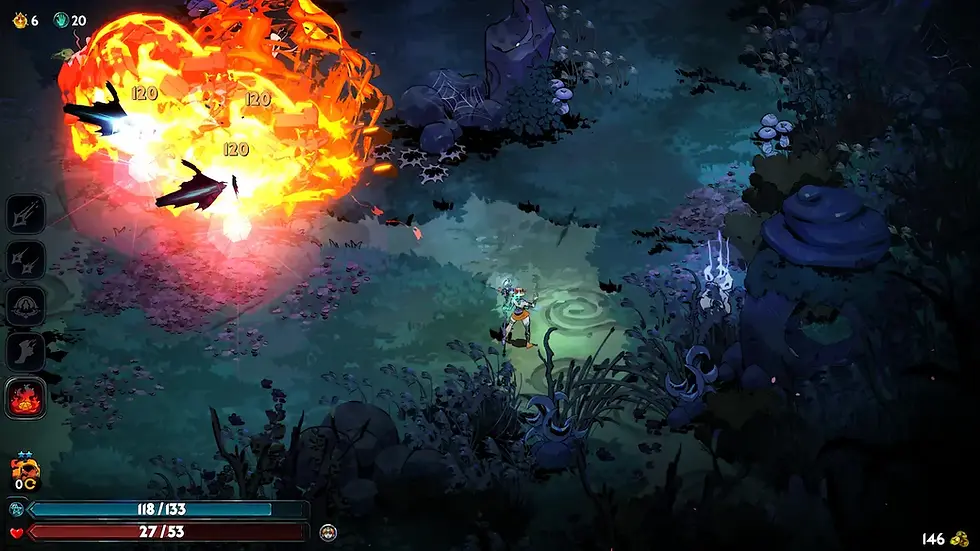
It's great against groups but the boss-killing power is lacking. I end up making up for that in the Fields with a nice attack ability from Zeus.
By the time I reach Chronos I have plenty of life and some damage mitigation. It's probably my best, most well-rounded build to date, and there's no Eris to hinder me this time.
He killed me anyway.

After my death (Technically these aren't 'deaths', I think Melinoë is casting a spell to save herself and return to camp), I have a vision of Hades giving baby Melinoë to Hecate for safekeeping.

In this scene we get some insight into what Chronos wants - in addition to taking over the House of Hades and trapping everyone in a moment of time (except Hades, for whom he opted to go with the 'large shackles and despair' imprisonment.), Chronos is after the three Fates.

Talking to Moros in camp reveals much more - Chronos has indeed captured the three Fates, and is somehow using them to give him the upper hand over the Olympians as he assaults Olympus itself.
Knowing that Olympus is under attack with the aid of the Fates inclines me to help sooner rather than later...
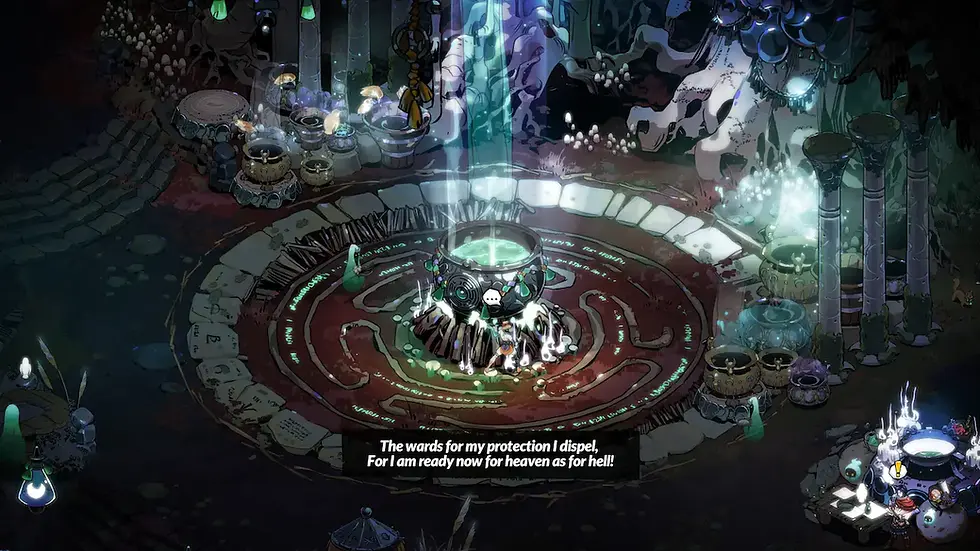
Olympus, here I come.
Run 10 (Olympus):

Right, I'd forgotten that the whole reason Zagreus has to beat Hades a dozen or more times is because he expires about 30 seconds after getting to his mom's house. I immediately start taking damage from being a Chthonic entity just breathing the air up here.

I only get through a couple rooms before the air brings me down and it's over. I simply can't survive up here for long.

Moros reveals that an incantation should help me survive up there. I check the ingredients, and there's two that I don't have - one is Moss which grows on the surface, the other is Thalamus which is a plant the grows in the realm of Chaos. I'll have to make more short-lived excursions to the surface for the moss and then keep making runs downward for the Thalamus before I can really attempt the path to Olympus. I also lucked out and managed to gather a bit of bronze to obtain the fishing pole back home. Run 11 (Olympus):
Got moss, choked to death - great success!
Run 12 (Underworld):
Trying the Moonstone Axe for the first time, it's simultaneously ponderously slow but compensates for it with amazing range. I feel like the Omega moves on this thing are especially important since it's basic strikes aren't particularly fast.

In Hades I, your 'ultimate' attacks were all granted by a variety of the Gods, with each on granting a separate ultimate. In Hades II, only Selene grants it to you as your Hex (and it's the only type of boon she offers). For the first time this run I encounter Selene a second time to find out how that works.

Anyway, the axe is slow and I got hurt by running into Chaos as much as I could to get the incantation ingredients. Sirens got me (and clawed out my eyes and drowned me to death per their hit single).
Fun bit about the Sirens battle - when you kill a band member their part of the song stops playing.
I don't yet have what I need for the survive-on-the-surface incantation but I do have all the seeds required, so getting up there is now just a matter of farming.
Also, some good news: Eris visits the crossroads and promises to stop 'Blessing' me.

Run 13 (Underworld):
This will probably not be an all-time successful adventure because I've disabled all of my arcana cards in order to fulfill a prophecy.

If Hades II follows the path of Hades I, at some point these boss battles will get tougher - potentially a LOT tougher, so it'll be easier for me to do this now while I'm facing normal Hecate than if I wait for her to get scarier.
Also, I'm trying out the the Argent Skull as my main weapon this time. It's a bit of a weird weapon in that you fire off skulls that you then need to retrieve, but I immediately take a liking to it - it feels versatile.

I take an Onion trinket this run which gives me limited healing to keep my health full for the Hecate fight, and I know the battle well enough by this point that I achieve this run's objective.

The lack of Arcana really does hurt, and it shows when I can't beat the Sirens for the second time in a row.
Run 14 (Underworld):
Early on this run I encounter this strange white bird for the second time. Hecate starts talking about animal familiars and I get an incantation that I presume will let me acquire one - I assume it'll be either this bird or maybe we'll bring Frinos the Frog with us.

This build gets off to a weird start when I start getting and enhancing the sheepifying Hex - initially it becomes a very Hex-based build where my attacks do very little except let me use the hex, which then turns all my foes into sheep, and if they die while being sheep they explode.

Also sometimes it turns my enemies into food, which resulted in this very strange battle where I ate a Naga.
I get Volcanic Flourish from Hephaestus again and I level it up enough so that it'll trigger every 2 seconds - I smashed through the Sirens and Cerberus with it easily. I don't have a lot of other abilities, but the ones have are excellent.
Time for another crack at Chronos. On the way I grab as much health and self-healing as I can - I've got the damage, now I need to be durable.

Yes! Death to Chronos!

What followed was a messy blow-for-blow slugfest that killed me. In fact, it killed me twice... but I had two death defiances thanks to upgrading my Arcana, and on my final life I laid the Titan low.


Now in many roguelikes, defeating the final boss would simply be the end of the game. In Hades, it is merely the end of the beginning - Chronos is only temporarily inconvenienced, and we have much more to accomplish before we truly win.
Melinoë gets started on her plan right away - she heads for Zagreus' bedroom, and casts an incantation upon the Mirror of Night there to contact her brother (to be precise, Zagreus in the past), who she's never met.

It's probably going to take several discussions through the mirror to get Zagreus to do anything useful, hence the need to defeat Chronos several times. After trying as hard as she can (and making at least some initial progress), Melinoë sends herself back to the Crossroads before Chronos finds out what she's up to.
In the training area, I've now unlocked the Oath of the Unseen, which is a fancy way of saying 'We'll reward you if you voluntarily make the game harder on yourself.'

My farming efforts have come to fruition, and I've now performed incantation that should let me survive on the surface - the Oath can wait for now while I give Olympus another shot. Upward, ho!
Run 15 (Olympus):
Now that I can be on the surface for more than 30 seconds, I can take my time and look around a bit.
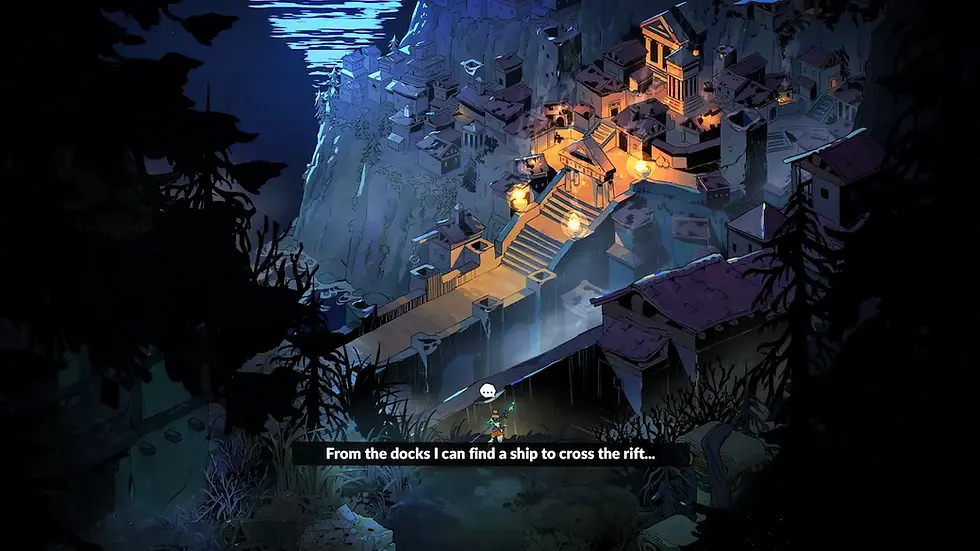
With a few exceptions the enemies here aren't too bad, though for some rooms the zombies just keep coming and it takes awhile to defeat them. The most notable thing about the city is that the structure of the level is a city square and you can choose your rewards from among all of your options at once.

I clear the rooms out without too much difficulty and proceed to annoy a shepherd just outside the city.

Unlike the mythical heroes of old, Melinoë isn't one to resort to trickery and employs the tried and tested methodology of excessive violence.
In a nod to mythology and perhaps an inability to explain why he might resurrect after being killed, the Cyclops just goes to sleep when you beat him.
Melinoë reaches the city docks, and sees a procession of ghostly ships headed for Olympus at the Rift of Thessaly.
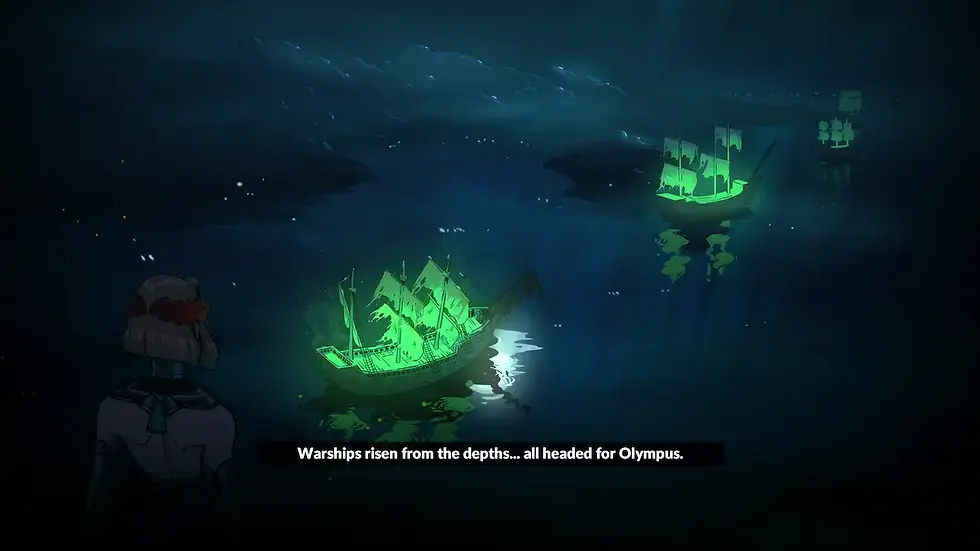
The battles here take place on the decks of a series of lost ships, and the undead sailors give me a lot of trouble and I get worn down by a nasty Captain with hand cannon that shoots bouncing explosive shots - a weapon I could really use, by the way. By the time I reach the boss I'm on my last legs.

I gave a good account of myself but when there's no room for error, death ensues. At the crossroads I perform the incantation to obtain Familiars - Frinos will be joining me on the next run. Reviewing what I need for a whole host of future incantations, my future decisions for whether to attempt an Underworld or an Olympus run will be entirely based on where I can obtain the materials, as the surface has a list of things not found in the Underworld and vice-versa. Right now I'd like to build a tavern at the crossroads which requires Nectar and Garlic - I currently have a Garlic seed planted from my last run, and I didn't see Nectar on the surface so I'm heading back down.
Run 16 (Underworld): Ok, I wasn't expecting Frinos to be the be-all-end-all of Combat Frogs, but I was hoping he'd be at least a bit more helpful than simply jumping around every so often. His benefits are mostly passive, and I guess that's better than nothing.
If you assumed we were done meeting new characters now that I've beaten the main baddie once, I have a bridge to sell you in San Francisco.

Lots of characters make Frinos-related comments, but my favorite reaction is poor Arachne's terror at my having brought a natural predator into her lair.

Hera's ability is neat, she puts a condition on enemies that causes them to share damage with each other, so it works best if I can put it on a lot of enemies at once - I happen to be using the Moonstone axe which has a massive Omega special, and with that plus a few other enhancements I've got a decent build cooking.

And to put a cherry on top, I pick up a really great Hera / Aphrodite combination power that automatically charms one of my enemies until there's only one left.

I'm regretting that I forgot to turn on the Oath of the Unseen for this run - the sooner I start making runs with it the sooner I'll benefit from its effects, and at least initially I suspect I'll be able to find settings that don't change the game's difficulty all that much.
During the second Chronos phase some hourglasses appear that shoot healing beams at him - except for the one that I charmed, which shoots ME with its healing beam - nice work programming the charm effect there.

Chronos falls again and Melinoë starts explaining the overall situation to Zagreus in their brief time together.
At the Cauldron, a new incantation is revealed that will prevent Chronos from resurrecting, but unlike the others I don't know the full recipe for it yet. I suspect performing this and then killing Chronos is how one wins the game, or at least accomplishes major story progression.

Run 17 (Olympus):
I turn on the Oath of the Unseen for the first time and give Olympus another whirl. If I can defeat Eris I'll get an extra reward for doing so.
This time around Heracles is here to warn me away from a city that I've managed to clear before.

Aphrodite's powers generally let you do bonus damage to enemies that are close (I guess that's the power of love?), but that restriction is removed when I pick up a boon that has all her abilities treat enemies as being close.

At the docks before entering Thessaly I encounter a cat for the second time, and since I have pet treats we hit it off and I've acquired a second familiar.

Battling my way through the ships I get unexpected aid in the form of someone helpfully dropping bombs on the deck from above.

I reach Eris in better shape than I did last time, and Icarus' gift was armor that when destroyed hits enemies (once) for a massive 4,000 damage - it chops Eris' health by almost a third, and I'm able to win the fight.
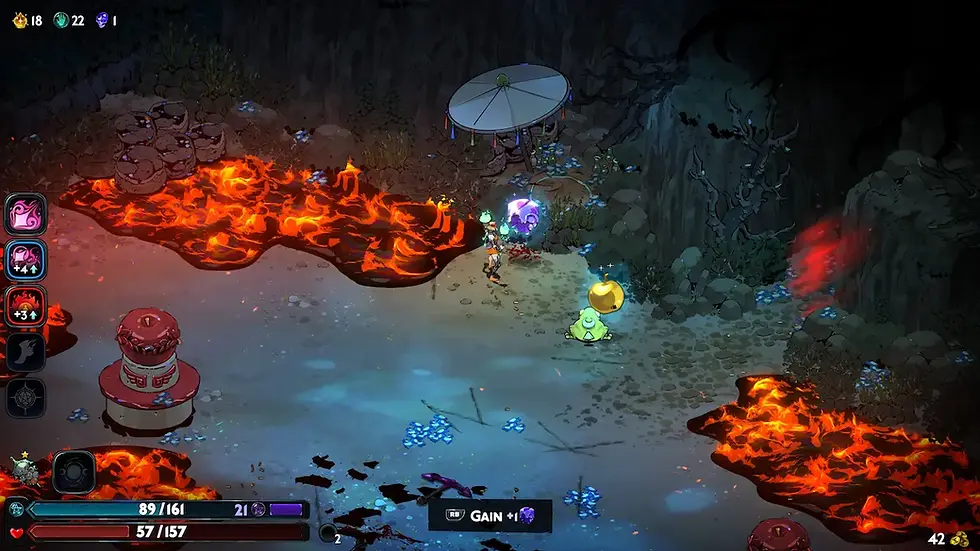
Having defeated Strife, grandiose music plays as Melinoë reaches the gates of Olympus itself.
The place isn't looking so hot.

These levels are stuffed to the brim with minions of Chronos as well as automatons that fight against them. I know this game plays fast and loose with mythology but I'm pretty sure it's the Illiad that describes the killer robots that the Gods use to keep their home safe.

Not everyone here is hostile - Athena shows up and smashes a whole room full of foes by way of introduction.


These battles are tough, and I wasn't exactly in great shape after Eris, but I limp all the way to the end where I run into Prometheus, who absolutely slaughters me in tandem with his Eagle.
Also, I really don't blame Prometheus for wanting to get a little (or a lot) of payback against the Gods.

I haven't written much about the main appeal of the game, for which I apologize for getting so far into before remarking on directly - combat is just plain fun as hell, and the sheer variety of builds you can make and then adapt your tactics to means that even though you're replaying the same levels over and over, it's pure concentrated joy. The levels may repeat, but every run is different - so much so that each time I'm considering what abilities to pick, how they'll mesh with what I've got, and how best to use them to win.
Run 18 (Underworld):
Toula the cat is what I was hoping for in an animal familiar - she fights AND has passive bonuses, like auto-catching fish. Frinos is going to enjoy the rest of his comfortable life in the crossroads unless I need him to fulfill a prophecy or something.

For the first time I'm seeing 'God conflict' rooms where you have boons from two Gods and you can get both, but the one you pick second gets pissed off at you and you have to clear the room while the God is throwing an additional complication your way. These rooms appeared much earlier in Hades I and I'm not sure why their appearance here is so delayed (possibly because they're extremely dangerous and ended many of my early Hades I runs).
To illustrate what I was talking about with builds, this time I've got the Sister Blades with Aphrodite's close-up damage plus a large backstab bonus, so the run starts with me darting in and out of combat trying to hit foes in the rear and darting away. Later on I get Hera's curse on my sprint, which means that enemies share damage once I run by them - and all of a sudden the main tactic I use changes from hit and run attacks to running around the entire room linking all of the enemies together and then smashing the toughest one, which causes all of the others to be hurt or killed.

Chronos falls a third time, and Melinoë starts getting into specifics of how we're going to beat Chronos for good.

Worse than complexity, Melinoë's plan to 'Undo the harm' Chronos has caused seems likely to create a paradox - if Chronos doesn't imprison Hades and time-freeze the family then Melinoë won't have been raised by Hecate to fight Chronos.
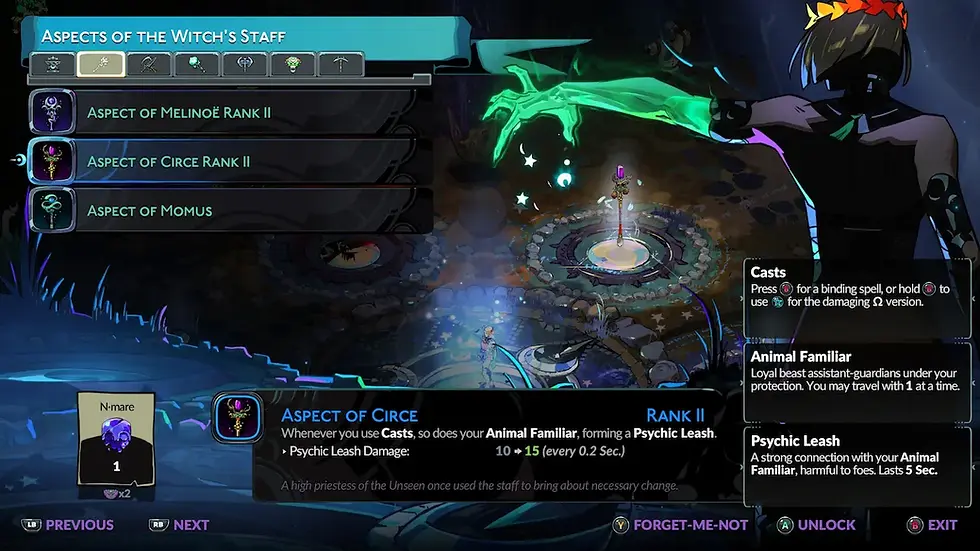
At camp I've unlocked the Aspects of weapons, giving each one two additional 'forms' that change their bonuses and characteristics.
Run 19 (Olympus):
Using the Axe I get a Daedalus hammer that gives me one giant slow axe attack. This ends up pairing in a fun way with the sheep hex where I can turn foes into sheep, summon them into a group, and then hit them all with a massive attack.
I've determined that each area has a singular NPC 'room encounter' in it, and on this run I meet a pair of witches in Ephyra and Thessaly. Perhaps on the surface there be Witches Three?


Big, chonky and slow isn't my preferred playstyle, and especially not in this game where the enemies and their attacks need constant avoidance. This build is too slow for me to avoid taking damage and I almost lose to Eris, then find my end shortly afterward in Olympus.
Between runs I try making a potion that should revive Hypnos. It backfires - all it does is bring me into Hypnos' dream.

I also unlock Chaos trials, which are runs that set you up with a less randomized build for you to try the game with. These don't seem to advance the story.

I cleared the available Chaos trials which the game regards as runs so I'm going to keep my numbering system consistent - since they don't advance the story I'm not going to record them and run gaps are attempts at the various trials. Run 25 (Olympus):
Another attempt with the axe, I ran into several of new foes this time.
First, I tried the Rivals oath which enhances the bosses, resulting in the Cyclops getting some help from Medea.

Then, apparently sensing that I was up for trying new things, the game threw Charybid... Charbi.. Charybdis at me in Thessaly.
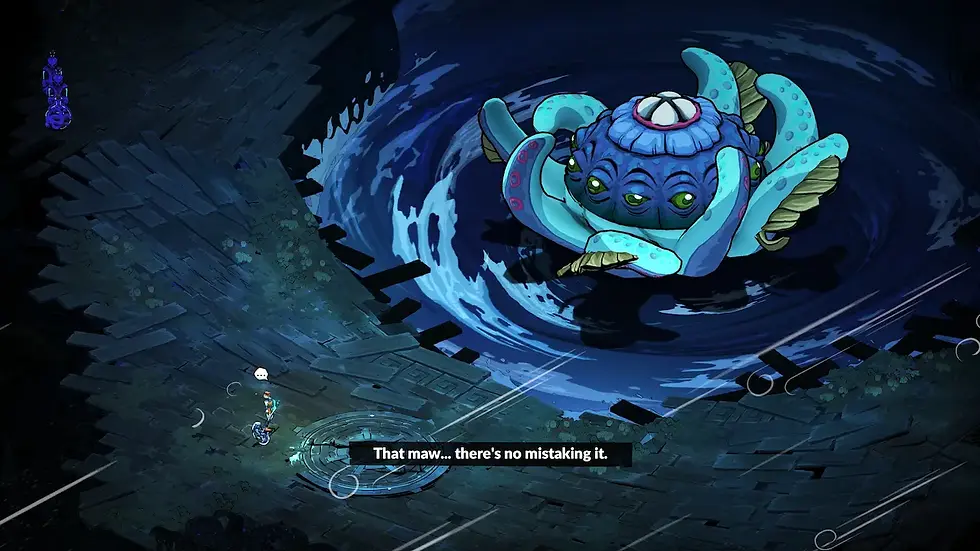
And finally I end up fighting a straight-up dragon that I didn't catch the name of, but it was real nasty and ended the run.

Run 26 (Olympus):
I've been wondering where Dionysus has been - in Hades he's one of the main Gods that offers you boons. Not this time! Dionysus has decided to just throw a party instead.

I have one hell of a build going here, it's using a Hex that turns me into an invincible incarnate and I have magic that regenerates quickly so I can spend a good portion of a fight being immune to damage. Prometheus is cast here as the Titan of Foresight - so he saw it coming but couldn't stop me this time.

For whatever reason in my head I was thinking that Prometheus was the final boss of the ascent to Olympus (and I'm not sure why, the Underworld path has four areas and so does Olympus). I'm still in relatively good shape when I reach the summit.

The feeling turns out to be justified - the enemies up here are insane.

These foes are just brutal, and while I'm sure part of that is that I haven't been here before, I figured that I still had enough juice to reach whatever's at the end of the Summit. They hit fast, they hit like trucks, and some can't possibly even fit on the screen.

I end up battling against a huge creature's tail and lose. Attempts on Olympus are significantly harder than the Underworld, this build would have absolutely wiped the floor with Chronos and wouldn't have broken a sweat getting to him. Run 29 (Underworld):
I returned underground to obtain some plants I need for various cauldron recipes as well as hopefully obtain the white bird I saw earlier as a new familiar.

I made it to Zagreus and Melinoë elaborates on her plan - we need to find a weapon that exists both in Zagreus' time and Melinoë's.

I've been mulling over why Hades is one of a very few roguelites that goes about telling a story, and part of it is that the structure of such a game makes it challenging - in terms of gameplay you are playing through the same areas and fighting the same bosses over and over, so where a 'normal' game could just tell you the story as you encounter characters and make steady progress over the course of the game, a rogue derivative has to tell a 'meta' story that doesn't quite follow the gameplay. Instead, your 'best' progress in the game marks an inflection point where the overall story can advance. One clear example was defeating Chronos for the first time was an event that everyone reacted to and began discussing. The characters in camp like Hecate that you will reliably meet and talk to are the ones that help advance the plot the most since the devs can rely on players encountering them. The other characters like the Gods that provide boons are essentially random encounters that you may or may not meet on any given run, so what happens there is that they will have comments from their own perspective about whatever is currently happening in the story - for instance when I was trying to get the materials to survive on the surface, as lot of gods made that the subject of their discussion. I say 'discussion' but Hades when it comes to mid-run conversations with Gods that you get boons from, they can talk to you but there's no way for you to respond back to them (You CAN deliver them a bottle of nectar which they react to, so it's unclear to me why I can't tie a note to it).
I'm enjoying the story of Hades II but I think the premise of Hades I where it's a family affair and you're directly interacting with the same father that just killed you was just a bit more compelling. I think part of what I enjoyed about it was that it wasn't a 'save the world' story - it was about Zagreus' independence and getting to meet his mother. This time with Chronos' forces knocking on the gates of Olympus, we're here to save the world. Run 32 (Olympus):
I'm using the Black Coat for the first time - as in the first game they've given us a very anachronistic weapon. The Rail of Adamant let Zagreus basically run around with an assault rifle.

I quite like the power and especially the range of this weapon, and I get all the way to the end of the Summit to encounter Typhon, Father of Monsters. Thanks to Dionysus I didn't know my own life total, nor do I know Typhon's, so during the fight I have no idea who's winning the battle until the end.
Sadly, it was my end.

Run 34 (Olympus):
I had almost assumed by this point that Ares was no longer a boon-granting God, because his Hades I ability appears to now be something Zeus grants. Not so!

The Daedalus hammer turns a very mediocre run into a powerful offense, and it's good enough to take me to Typhon again - but not yet good enough to beat him. At least I picked up another familiar (I now have both of Hecate's pets at my disposal) and every run is still making me stronger. I've unlocked all the Arcana cards but I'm a long way from fully upgrading them.
Run 35 (Underworld):
I was hoping to find the bird again - I think it's the last familiar I don't have yet - but no luck there. I killed Chronos again and Zagreus proposed using Hades' spear Gigaros against Chronos, if we can somehow let Melinoë access it.
Run 36 (Olympus):
I'm using the Black Coat, this time with the Aspect of Selene which gives me a unique Hex. The Sky Fall Hex is powerful enough for me to try to build around using it, but the star of the show begins with Demeter's icy missiles that freeze enemies in place from a safe distance.

One thing that I've been wondering was how Chronos learned where the Fates were - we know he interrogated Hades but Hades claims that he had no idea where they were and thus couldn't reveal the information.
When Melinoë brings it up during a conversation with Chaos, the mystery is solved.

I've changed the way I set up Arcana for the last few runs. Instead of picking a full set, I'm only activating three other cards (Death defiance and extra health, because durability is king) in order to activate the Judgement card. Judgement activates three other random Arcana cards when you defeat a boss, and now that it's fully upgraded it activates five - so by the time I've beaten three bosses, I'm a fair bit more powerful than I would be without it.
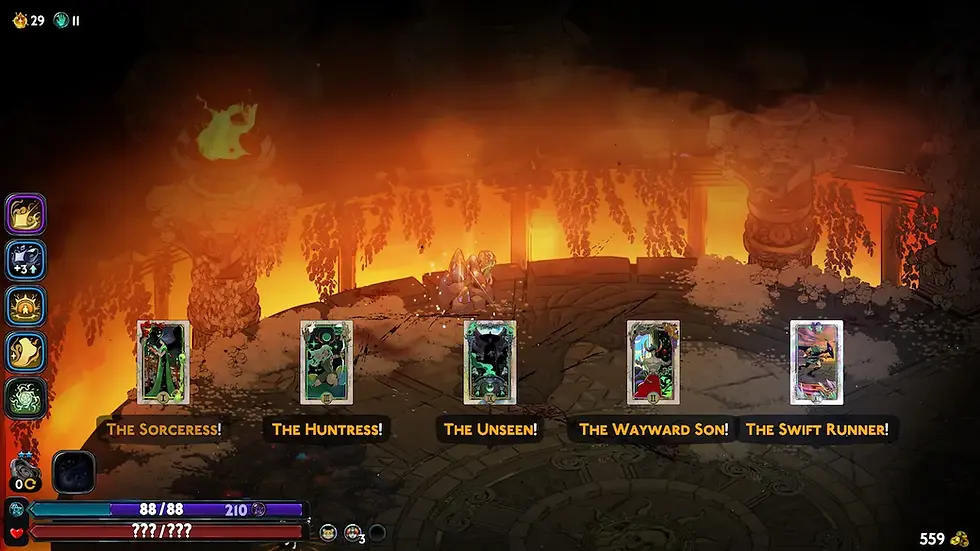
I get a really nice synergy when I pick up an ability that sets my minimum damage to 50 - that turns insignificant abilities like Demeter's whirlwind, which normally does 4 damage per hit, into devastating attacks. My survivability goes through the roof by picking up both the 'get lots more health but you can't see it' boon from Dionysus and a once-per-location death defiance from Athena.

I've got great offense and defense approaching Typhon for the third time, but most important: I feel good about this run.
I took a moment to record the battle. That Sky Fall Hex really does an incredible job of clearing up the monsters Typhon throws out during the fight.

With Typhon (temporarily) defeated, Melinoë at last finds a nice neighborhood in Olympus where she gets to meet her relatives in person.

Now that Typhon has been defeated, I suspect I need to keep defeating both him and Chronos to reach the end. Killing Chronos advances the planning with Zagreus, but initially I'm less clear on how repeatedly defeating Typhon helps advance Melinoë's goal - that's remedied when I beat him again a few runs later, and another incantation is revealed that can get rid of Typhon for good. I'm going to need to obtain Gigaros by defeating Chronos enough for Zagreus to obtain it and somehow deliver it to me - it's an ingredient in Typhon's demise - along with several of Typhon's flesh samples, so Typhon needs to die a couple more times before I can get rid of him for good. Once defeated, I think Typhon will drop the last ingredient I need to defeat Chronos once and for all.
Incidentally, there still appears to be no way to revive Hypnos yet - I'm starting to suspect I'll need to fully defeat both Typhon and Chronos and then wake him up.
I'm currently on Run 44, and there's been an intriguing story development. Zagreus has expressed some reluctance to help with the plan to kill a relative he's never met, and now Hades too doesn't seem particularly driven by a thirst for bloody vengeance.

I'm still on a path to permanently vanquish both Typhon and Chronos, but I'm starting to wonder if a more peaceful reconciliation could be in the cards here.
I'm also enjoying the side stories that are playing out - Echo is apparently lost in the field of mourning because of her unrequited love for Narcissus, and the latter is actually making a minor effort to help out. Curiously (And I suspect I know where this is going), my spirit-friend and area-decorator Dora once associated with Prometheus, though she's struggling to remember anything about it and Prometheus isn't forthcoming.
Bagging Typhon for the fourth time on run 46, I've reached the requirements for the ritual that will get rid of him for good (once I slay him again) - and doing so will drop what I need for the ritual to do the same to Chronos.
Run 47 (Olympus):
Typhon falls, and stays dead.

Run 48 (Underworld):
With the final ritual complete it's time to take one last crack at Chronos. Chronos has his own surprise in store - this time he finds Hecate before she can fight me and captures her.

I've unlocked a hidden Aspect of the Sister Blades for this run, Aspect of the Morrigan, which encourages you to perform a variety of attacks that trigger a big hit on your opponent.

Chronos has one final trick up his sleeve - after his normal two-phase boss fight he has one last bid for survival by giving Melinoë a glimpse of a world without time, and launching into a third phase.

With Chronos defeated here, we then see Zagreus encounter Chronos in the past and offer him a chance to surrender quietly rather than die. Chronos doesn't take the offer, and Zagreus tries to stab him with Gigaros - and then what exactly happens is a bit unclear, but I think Chronos, Zagreus, Melinoë, and the rest of the trapped members of the House of Hades experience a possible timeline of what would have happened if Chronos had simply tried to talk things out rather than taking over.
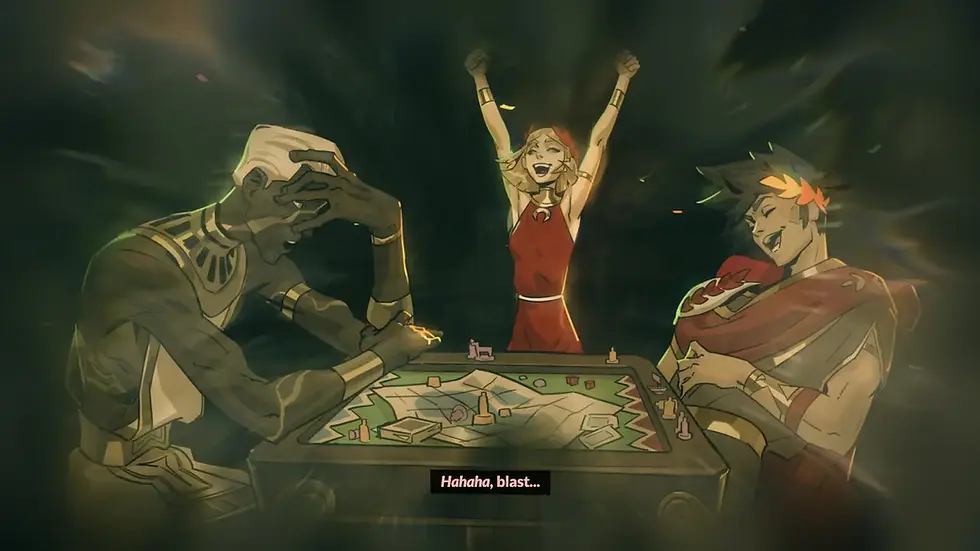
Turns out that alternate possible timeline was pretty great for everyone, Chronos included. Chronos is deeply affected by this vision of the path not taken, and the experience changes him - he surrenders to Melinoë and submits himself to her judgement.
Thus, there is peaceful reconciliation in the end, with Chronos trying to atone for his errors - and help clean up the mess he caused. Not everything is fixed - Hypnos is still asleep, the underworld and overworld are still teeming with foes, the three Fates are still missing (Chronos forgot where he put them...) and there is much more to be done, but as this blog post is now possibly my longest ever, I'm going to end it here at this ending, where Melinoë has achieved what she set out to do:

I'd heartily recommend both of the Hades games to anyone, they're a ton of fun and both feature a 'God mode' in the options that gradually makes the game easier to the point where anyone can beat it.
Whatever Supergiant wants to make next, I'm in.


soi cầu miền bắc hôm qua mình đang ngó lịch ngày 3 9 2026 nên tiện lướt sang xem thử họ trình bày ra sao cho dễ theo dõi, kiểu cần thấy nhanh mục nào dành cho đúng ngày đó là được. Thấy họ tách riêng “Soi cầu MB ngày 3 9 2026” nên nhìn một cái là định vị được luôn. Đỡ phải kéo tìm lung tung. Phần “Dự đoán XSMB hôm nay” cũng để thành một khối nội dung rõ ràng, đọc lướt vài dòng là hiểu họ đang nói gì. Chữ không bị rối. Mình chỉ xem cách sắp xếp thôi, không bàn đúng sai. Nói chung ai thích xem nhanh thì hợp. Mấy tiêu đề như…